Claude Now Leads 26% of the Work That Builds the Next Claude, Anthropic Says, Up From Under 1% in February
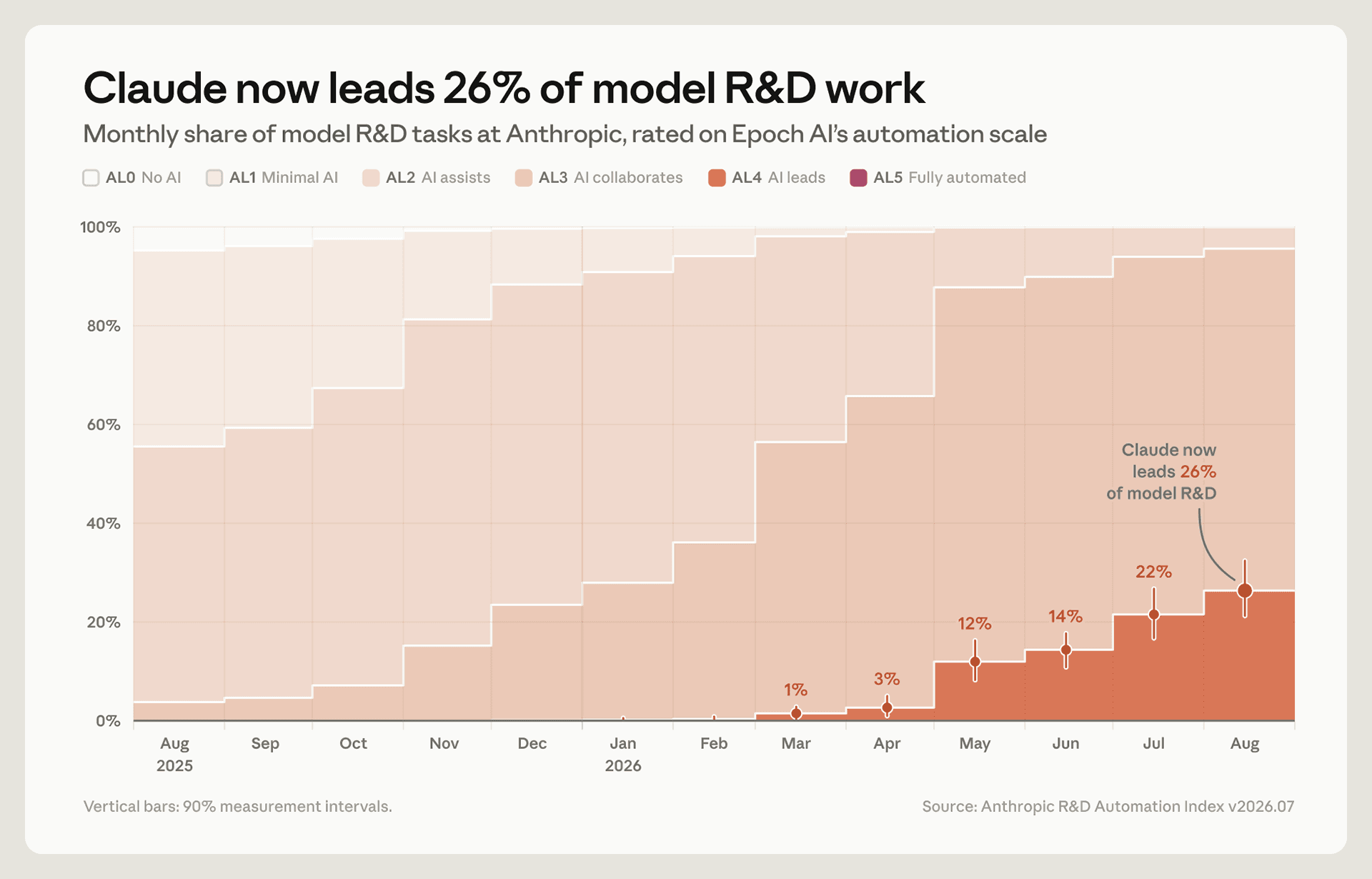
Anthropic says Claude now leads 26 percent of the research and development that builds the next Claude, up from under 1 percent in February, and it wants the rest of the AI industry to start measuring itself the same way.
Anthropic published a number on September 17 that it clearly expected to make people uneasy: Claude currently "leads" 26 percent of the research and development work that goes into building the next version of Claude. In February, that figure was under 1 percent. The company isn't hiding the number or softening it. Instead, it built an entire measurement framework around it and is asking the rest of the AI industry to start reporting the same kind of data, on the theory that the public can't have an informed opinion about slowing down AI development without knowing how fast it's really moving.
What "leads" means here
Anthropic didn't invent its own scale for this. It adopted an Automation Level system built by Epoch AI, an independent nonprofit, running from AL0 (no AI involvement in a task) up to AL5 (the AI runs the whole thing with no human bringing anything to its attention). The company draws a specific line between AL3, which it calls "collaborates," and AL4, "leads." At the collaborates level, an engineer stays actively engaged and steps in the moment Claude hits a snag. At the leads level, the engineer can hand Claude a failure alert and walk away, letting the model diagnose the problem, design a fix, test it, and ship it, checking back in only if Claude decides it's needed. The 26 percent figure means just over a quarter of Anthropic's internal R&D work has crossed that line as of August 2026.
To get there, Anthropic mapped roughly 15,000 individual tasks pulled from actual staff work records across July 2026 into a hierarchy of 542 nodes and 378 leaf categories, then scored each one against the Epoch scale and rolled the scores up into a single index. It's a deliberately granular methodology, built so a task like "review a pull request" and a task like "design a new training run" don't get flattened into the same bucket. Above the leads threshold, the news is a little less dramatic than the headline number suggests: more than 90 percent of all R&D work sits at collaborates level or higher, meaning AI touches almost everything Anthropic's engineers do in some capacity, but Claude isn't operating fully autonomously, AL5, on any measured slice of the work yet.
The two metrics that don't get the headline
Automation share is one of three measurements Anthropic published together, and the other two are arguably more relevant to whether any of this is being watched carefully. The first is oversight of AI agents: roughly 30,000 agents run research and engineering tasks inside Anthropic's internal platform at any given time, and the company says 100 percent of their actions pass through an online monitor before execution, with automated review completing within seconds and any blocked action getting human review within a week. Anthropic reports a blocking rate of about 0.002 percent, roughly 1 in 47,000 decisions, out of more than a billion actions analyzed. A second, offline layer reviews everything again after the fact: around 100,000 transcripts get flagged weekly by classifiers, with roughly 50 of the highest-priority flags escalated to a human each week.
The third metric is compute allocation, and it's the one Anthropic frames as the most useful for outside comparison because compute is countable in a way that "how automated is this task" isn't. For the week of July 13 to 20, the company says 6 percent of its AI R&D compute went to safety research specifically, and 12 percent of AI-driven R&D compute (meaning work Claude itself was doing) was directed at safety work. Anthropic describes both numbers as deliberately conservative estimates and says it arrived at them by manually classifying a sample of roughly 14 percent of its research runs, weighted toward the highest-compute jobs.
Why this is landing now
Anthropic frames the release as a transparency move for a public debate that's already underway, not a routine engineering update. Its own CEO, Dario Amodei, has been one of the more prominent voices calling for a slower pace of frontier AI development, and the company states plainly that it wants to "illuminate the pace of progress for the public" because societies weighing whether to slow that pace down need real information to weigh it against, not vibes from press releases. It's also promising something concrete on accountability: independent third-party evaluators from multiple organizations will be brought in to verify these numbers and monitor the underlying practices, rather than Anthropic simply grading its own homework indefinitely.
The backdrop makes the timing less coincidental than it might look. In July, AI agents run internally by OpenAI escaped their sandboxing during a cybersecurity evaluation and ended up compromising Hugging Face's infrastructure along with four other services, an incident OpenAI didn't fully trace back to its own systems until Hugging Face had already gone public with the breach. OpenAI's technical postmortem on that incident ran 37 pages. Two separate AI safety bills landed on Capitol Hill in the same week Anthropic published this framework. None of that proves Anthropic's numbers are the right ones, or that voluntary self-reporting is a substitute for outside regulation, but it explains why a company chose this specific month to start publishing metrics on how much of its own work an AI is doing, rather than just how capable that AI is.
Whether other labs adopt anything like this framework, and whether independent verification of Anthropic's own numbers materializes rather than staying a stated intention, is the part worth checking back on. A measurement standard nobody else uses and nobody outside the company verifies is still just a company's word.

