Four Indian Startups Just Made Google DeepMind's First-Ever Climate AI Accelerator

Four Indian startups just made Google DeepMind's first-ever climate-AI accelerator cohort, out of only 16 selected across the whole Asia-Pacific region. Three of them are betting on the same idea: that AI can turn a smallholder farmer's land into a source of carbon credit income.
Google DeepMind picked its first-ever cohort for the AI for the Planet Accelerator this week: 16 organizations from across Asia-Pacific, working on AI applied to climate and environmental problems. Four of the 16 are Indian: Terrastack, Varaha Climate, Farmers for Forests, and Climitra Carbon.
That's a quarter of an entire region's slots going to one country, in a program Google is running for the first time. Worth unpacking what these four companies build, because three of them are chasing a version of the same idea from different angles, and this is the first time this site is covering the Startup News beat at all, so it's worth setting the bar for what we'll actually dig into here: not funding headlines, but what a company is building and whether the underlying bet makes sense.
The Program Itself
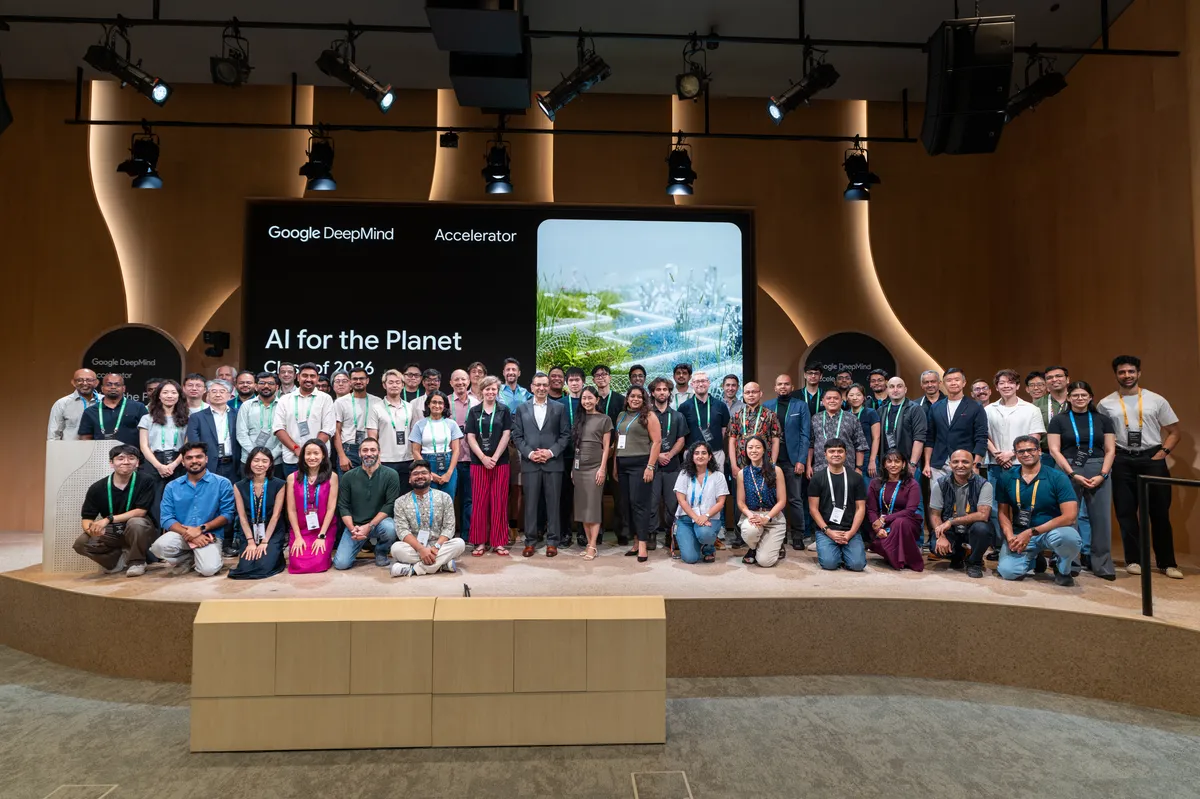
Selected teams get three months of access to Google's AI stack, along with technical support and mentorship, aimed at helping them scale solutions to environmental problems specifically, not general-purpose startup support. This is DeepMind running its own accelerator rather than Google's broader startup programs, which signals the company sees climate-focused AI as a distinct enough category to warrant its own pipeline, not something to fold into an existing initiative.
That distinction matters for what kind of company gets picked. A general startup accelerator optimizes for whichever founders pitch best. A DeepMind-run, climate-specific one is closer to Google deciding, in advance, which environmental problems it thinks AI can actually move the needle on, and then finding the teams already working on exactly that.
Three Startups, One Underlying Bet: Farmland as a Carbon Asset
Terrastack, Varaha Climate, and Farmers for Forests are all, in different ways, betting that AI can turn a smallholder farmer's land into a measurable, sellable climate asset, not just a source of crops.
Terrastack
Terrastack combines satellite imagery with agronomic data to give plot-level land intelligence to smallholder farmers, the kind of precise, per-field insight that used to require either expensive private surveys or simply wasn't available at all to a farmer working a few acres. India's last Agriculture Census (2015-16) counted roughly 125.8 million small and marginal farm holdings, about 86 percent of all operational farms in the country, most of which have never had access to the kind of data-driven land assessment a large commercial farm takes for granted.
Varaha Climate
Varaha Climate goes a step further commercially: it helps smallholder farmers actually earn carbon credits, using remote sensing and AI to verify regenerative agriculture and carbon removal practices on their land. Verification has historically been the expensive, slow part of any carbon credit scheme. Someone has to confirm the claimed practice actually happened, at scale, without physically visiting every field, and that cost has kept most smallholder farmers locked out of carbon markets entirely, even when their farming practices would otherwise qualify. AI-based remote verification is what makes this economically viable for a farmer with a few acres rather than only for large industrial operations with the budget for manual audits.
Farmers for Forests
Farmers for Forests applies AI-powered drones to agroforestry specifically, turning what smallholder farmers are already doing (planting trees alongside crops) into carbon and biodiversity outcomes that can be measured and counted, rather than assumed. That measurement step is what separates a genuine carbon-credit-eligible practice from something that just sounds good in a sustainability report.
Put together, the pattern is hard to miss: verification, not the underlying farming practice, is the bottleneck these three companies are all attacking. If AI can make it cheap and reliable to confirm what's happening on millions of small plots of land, the actual constraint on smallholder farmers earning carbon income shifts from "prove it" to "just do it."
The Fourth Is Solving a Different Problem
Climitra Carbon stands a bit apart from the other three. It uses Geo-AI to verify the removal of invasive plant species, which are then used as feedstock for biochar production. That turns an ecological cleanup problem into both a carbon-removal method and a usable material output. It's climate-AI too, but aimed at restoration rather than at monetizing existing agricultural practice, and it's the one company in this cohort whose output is a physical product (biochar) rather than a verified claim.
Why This Is Worth Watching Beyond the Announcement
A funding round is a bet that a company might work. An accelerator selection from Google DeepMind, specifically for AI-for-climate applications, is closer to a signal about where a major AI lab thinks the genuinely useful, deployable applications of this technology actually are right now, distinct from the frontier-model headlines most AI coverage focuses on. Three months from now is when it'll actually matter: whether any of these four have real user or revenue numbers to show, not just a cohort badge to put on a pitch deck.
For India specifically, this is also a data point in a bigger pattern this site has been tracking all year: a lot of the most commercially serious applied-AI work happening in the country right now isn't chasing the next chatbot. It's aimed at agriculture, land, and climate, verticals where India has both the scale of smallholder farmers to build for and, increasingly, the AI talent to build with. Whether that's a genuinely durable advantage or just where the easiest wins happened to be this year is exactly the kind of question worth revisiting once this cohort's three months are up.
Know any of these four teams, or working on something similar? We'd like to hear from founders in this space directly for future coverage.


