DeepSeek V4.1 Flash: A $0.22-per-Million-Token Model That Beats Claude Opus 5 on Two Benchmarks
DeepSeek's new V4.1 Flash model prices input tokens at $0.22 per million, the cheapest among tracked providers, and still beats Claude Opus 5 on two coding benchmarks.
DeepSeek released V4.1 Flash on September 10, priced at $0.22 per million input tokens and $0.66 per million output tokens through Fireworks, the lowest rate among providers currently tracked for a frontier-class model. At today's exchange rate that works out to roughly ₹19 for a million input tokens, cheap enough that a developer could process the text of a small novel for less than the cost of a cup of chai. The pricing alone would make this a story. What makes it a more interesting one is that DeepSeek didn't cut corners to get there: on two independent benchmarks, V4.1 Flash outscores Anthropic's Claude Opus 5.0, a model that costs many times more per token to run.
What changed under the hood
V4.1 Flash is a 552-billion-parameter Mixture of Experts model built on what DeepSeek calls a Causal Encoder-Decoder structure: 40 layers split into a 20-layer causal encoder feeding a 20-layer decoder. Only a sliver of that 552B ever activates for a given request, 8B parameters during the prefill phase and 16B during decode, which is the standard MoE trick for getting a big model's knowledge without paying a big model's compute bill on every token.
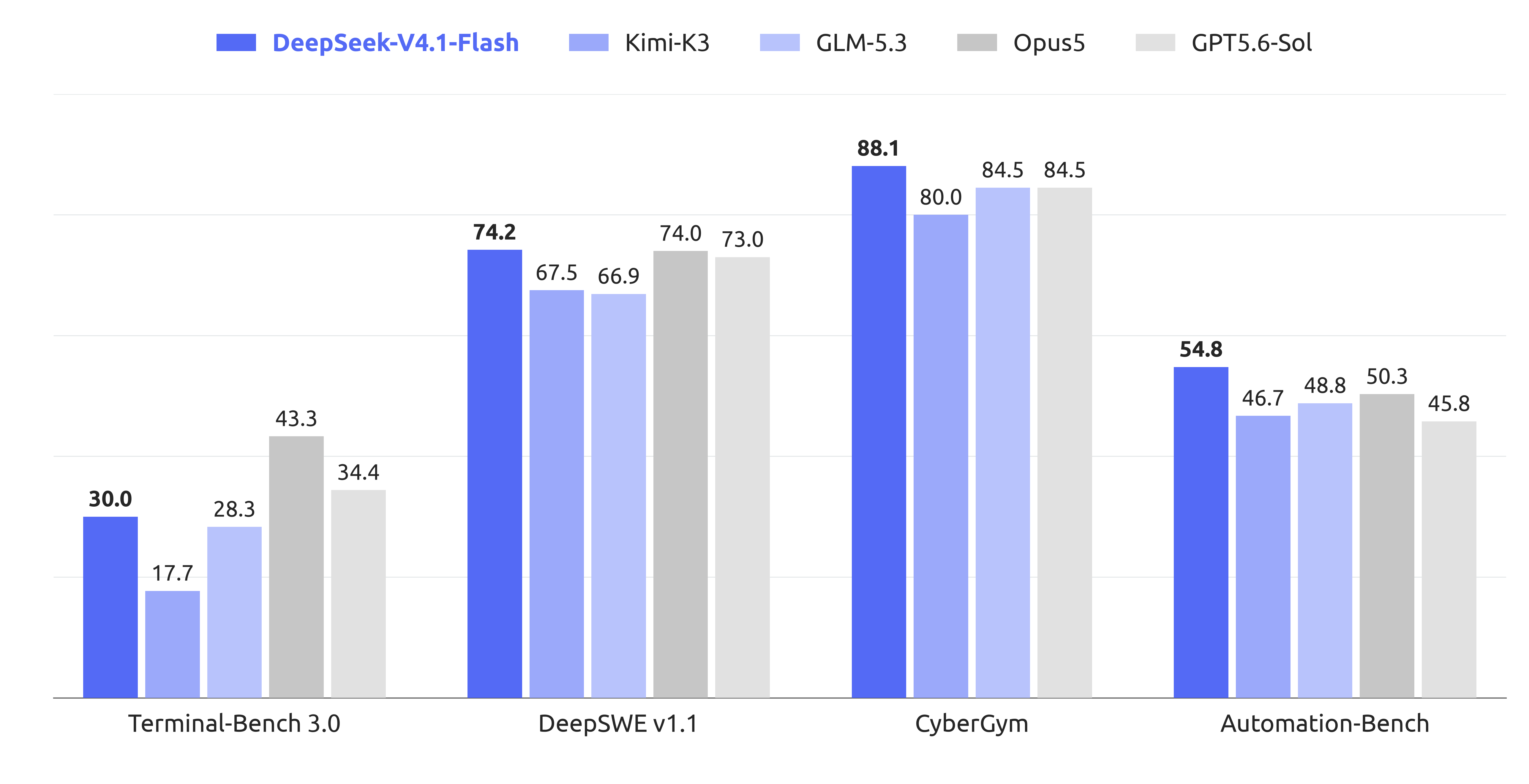
The more unusual engineering is around memory. DeepSeek's technical report describes several stacked techniques working together: SWA Bounded Replay, which reconstructs missing key-value states by replaying recent tokens instead of storing all of them; Compressed Sparse Attention 2, which sorts attention layers into Full, Reindex, or Reuse modes depending on how much of the context they still need; and FP4 caching that gets the global KV cache down to roughly 890 bytes per token. DeepSeek claims this adds up to a fourfold reduction in cache size compared to the previous V4 Flash release, and a 437-fold reduction compared to the original V1 model from years earlier. In practical terms, that's the difference between a model that can hold a long agentic session in memory cheaply and one that starts choking on context the moment a task runs long, which matters more than raw benchmark scores for anyone running agents in production rather than just chatting.
The benchmark numbers, and who they're being compared against
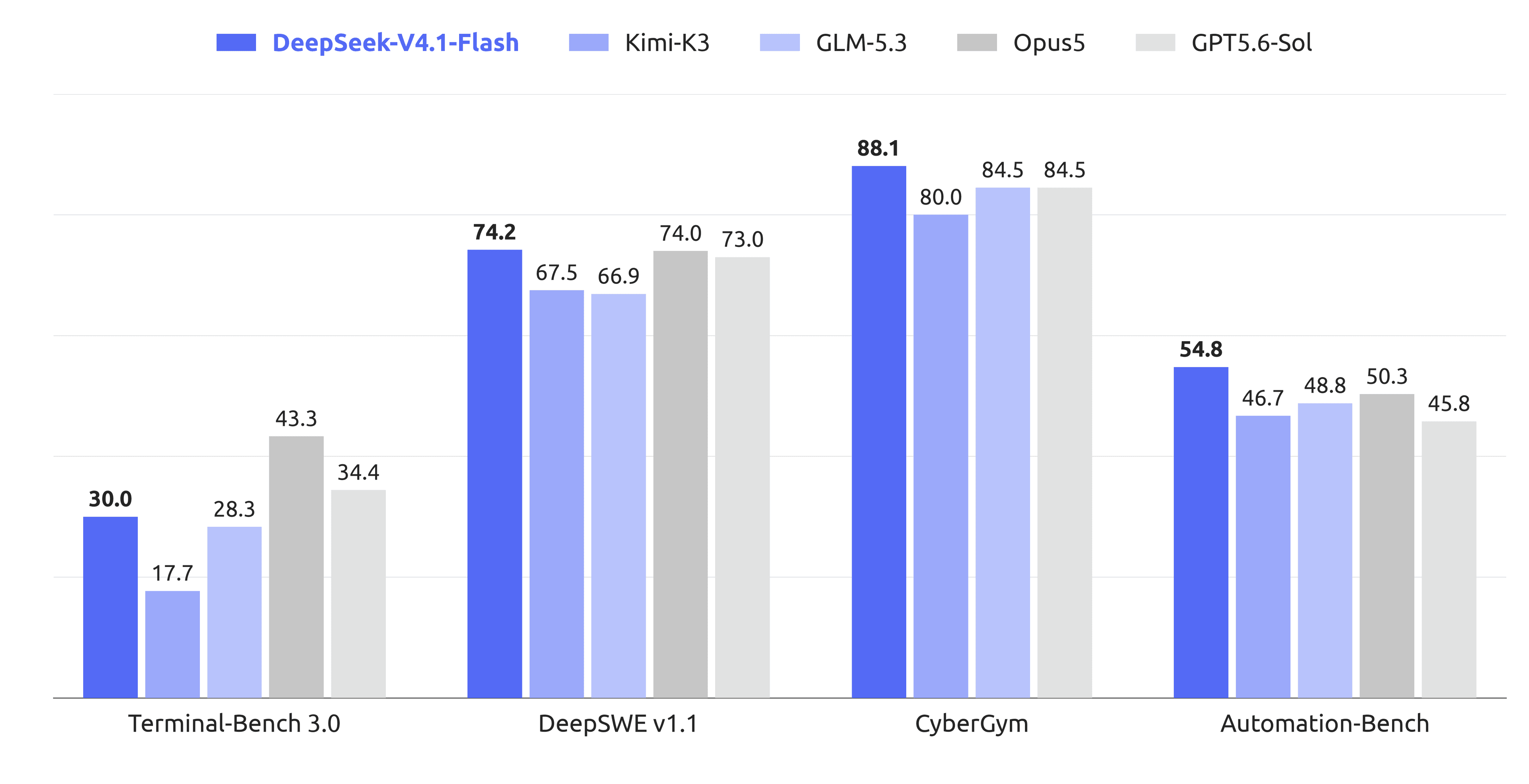
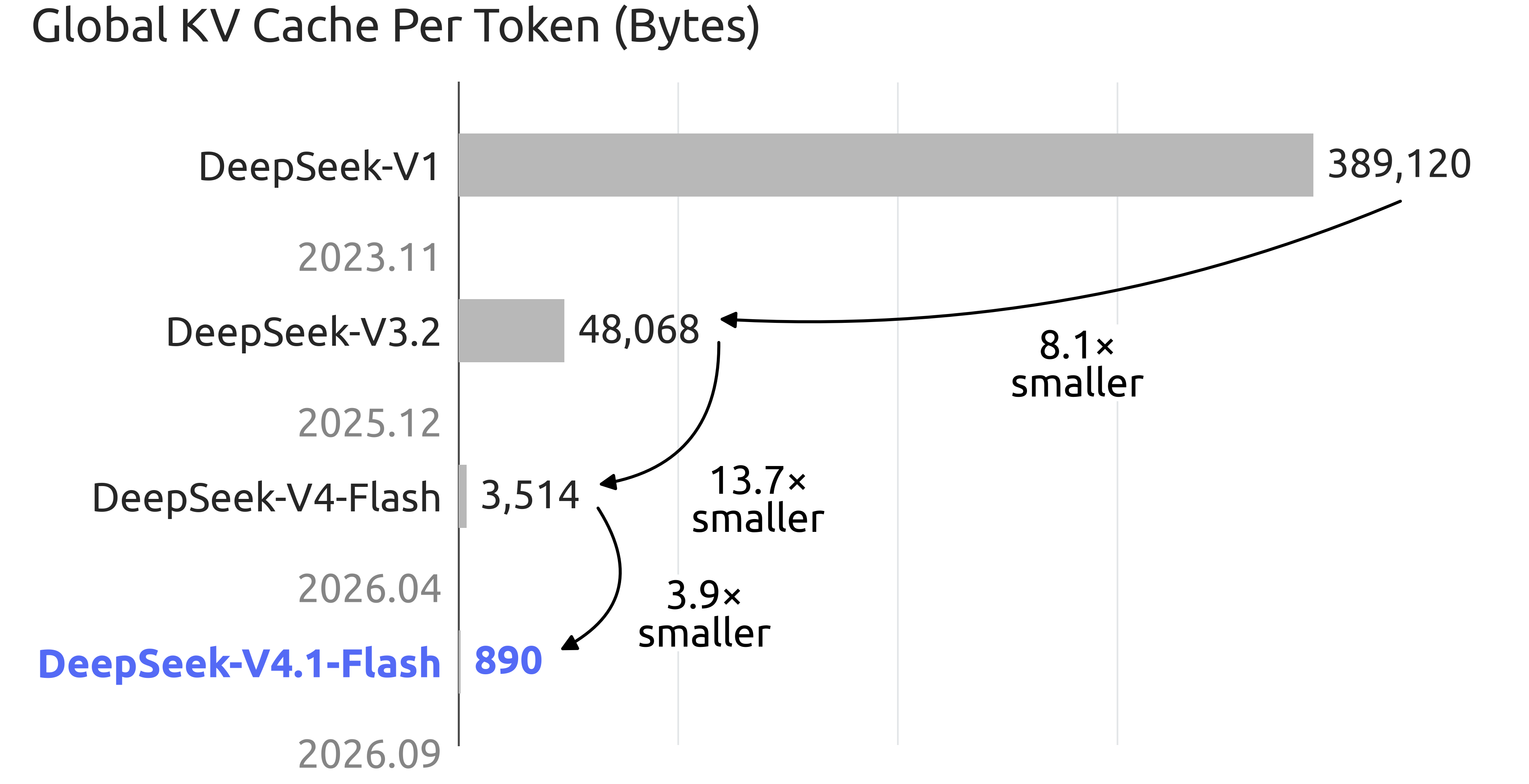
DeepSeek published head-to-head numbers against Claude Opus 5.0, GPT-5.6 Sol, and GLM-5.3, three models that all cost substantially more to run than V4.1 Flash. On Terminal-Bench 2.1, a test of a model's ability to complete real tasks inside a Linux container, V4.1 Flash scored 90.6 percent, ahead of Opus 5.0's 89.1 percent. On Codeforces, the competitive programming benchmark, V4.1 Flash posted a rating of 3,471, ahead of both Opus 5.0 (3,348) and GPT-5.6 Sol (3,289). On DeepSWE v1.1, a software engineering benchmark run with a full 1-million-token context window, it matched Opus 5.0 almost exactly, 74.2 percent versus 74.0 percent, and beat GPT-5.6 Sol's 73.0 percent.
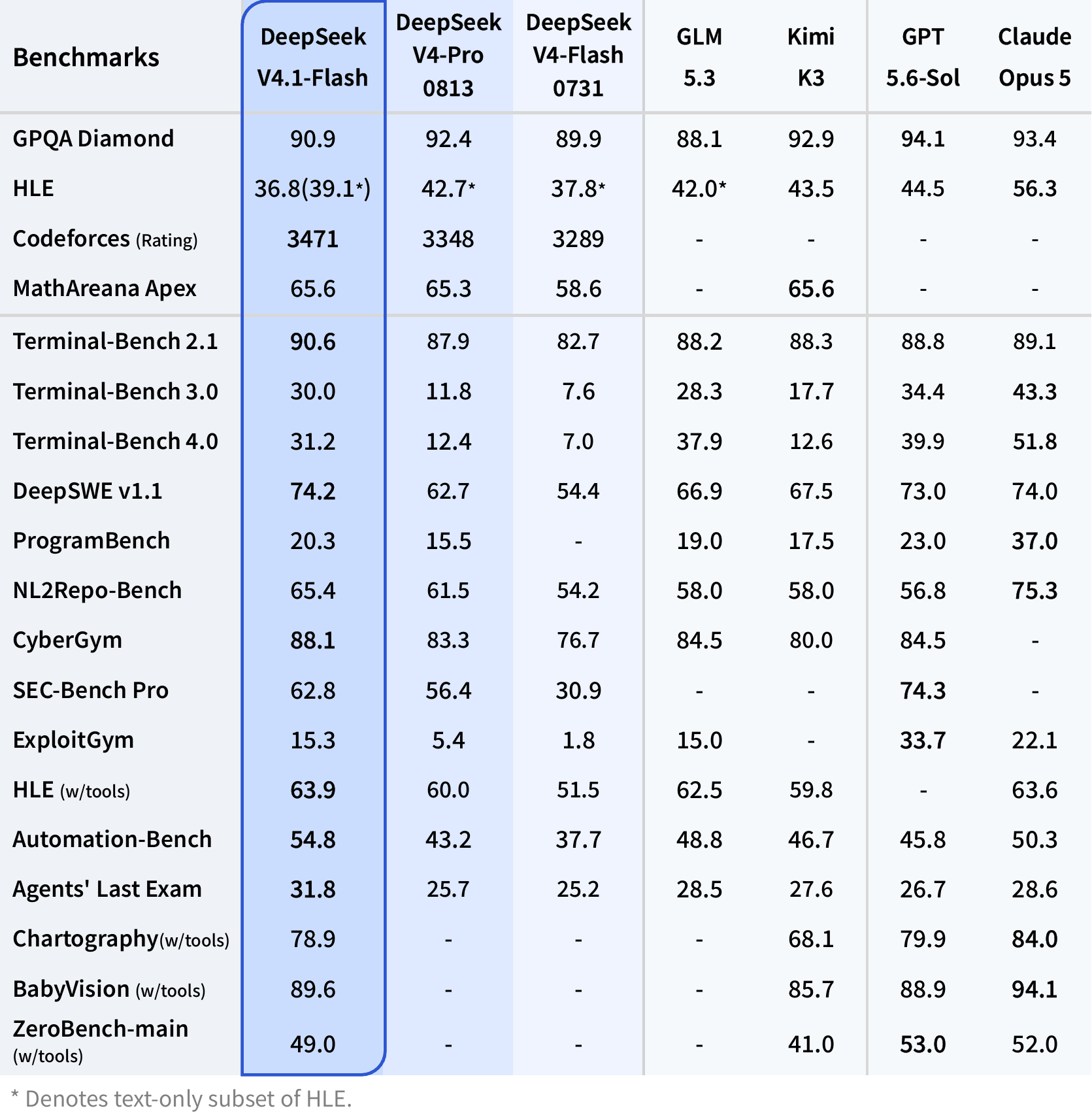
It doesn't win everywhere. On GPQA Diamond, a hard reasoning benchmark, V4.1 Flash scored 90.9 percent against Opus 5.0's 93.4 percent and GPT-5.6 Sol's 94.1 percent, a real gap rather than a rounding error. The honest read is that V4.1 Flash isn't a strictly better model than the frontier options it's being compared against. It's a model that gets close enough on general reasoning while pulling ahead on the specific agentic and coding tasks DeepSeek optimized for, at a fraction of the price of any of them.
Against DeepSeek's own prior release, the jump is sharper. Terminal-Bench 2.1 climbs from 82.7 percent in the V4 Flash 0731 build to 90.6 percent now, and DeepSWE v1.1 goes from 54.4 percent to 74.2 percent, a 20-point improvement attributed to new pretraining methods combined with larger-scale reinforcement learning during post-training.
Multimodal, and what it means for anyone building on this
V4.1 Flash also adds native visual understanding, meaning the model can process images directly rather than through a bolted-on vision module, scoring 95.6 percent on DocVQA (document visual question answering) and 86.0 percent on RefCOCO, a benchmark for locating specific objects described in text within an image. That's a meaningful gap closed against Gemini and GPT-class models, which have had strong native multimodal support for longer.
The model ships under an MIT license with weights available on Hugging Face, so it can be self-hosted, not just accessed through DeepSeek's API. For Indian developers and startups running AI agents, this combination (frontier-competitive agentic performance, truly open weights, and API pricing an order of magnitude below Western frontier labs) is the more practical story than any single benchmark win. DeepSeek is also keeping V4-Pro available past September 14 for anyone not ready to migrate, and older model identifiers like deepseek-v4-flash will temporarily route to V4.1 Flash automatically, so existing integrations shouldn't break overnight.
Whether this closes the gap with Western labs or just resets it at a new, cheaper price point depends on what OpenAI and Anthropic do next. Historically, that answer has come within weeks, not months.