iPhone Duo First Impressions: Apple's ₹2,99,900 Foldable Is Here — But Who Is It Actually For?
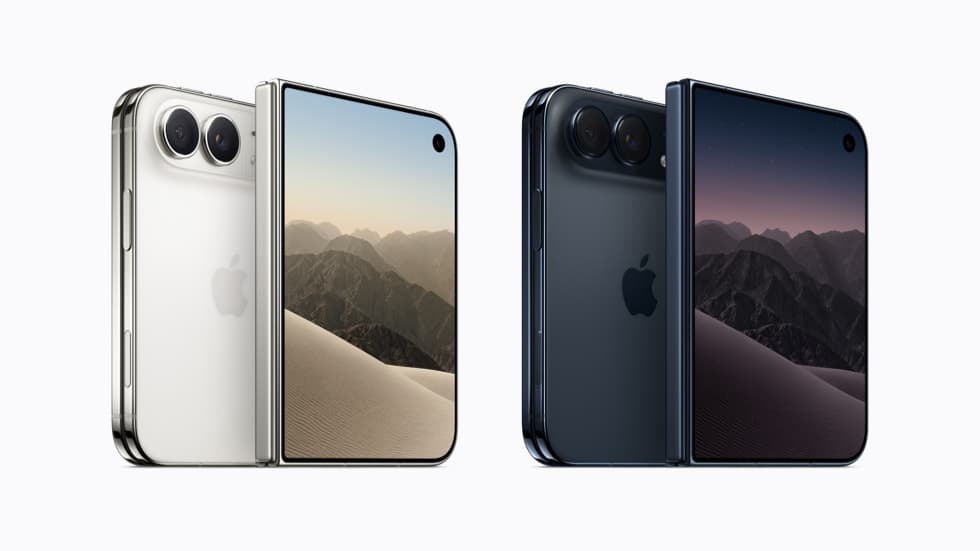
Apple's first foldable is official: a 7.6-inch inner display with a nearly invisible crease, an A20 Pro chip, and a starting price of ₹2,99,900 in India. First impressions on the spec sheet, the price, and exactly who this phone is for.
Apple finally has a foldable. On September 9, the company pulled the wraps off the iPhone Duo, a book-style fold that opens into a 7.6-inch inner screen, right alongside the iPhone 18 Pro, the 18 Pro Max, and a new Apple Watch lineup. It also happened to be the first keynote fronted by John Ternus as CEO, which is its own story for another day. Pre-orders start October 16, the phone hits stores October 23, and India is on the day-one list.
I haven't touched a unit yet, so treat this as a first look built off the spec sheet, Apple's own materials, and the handful of outlets that got hands-on time first. What I want to get at isn't "is it good." Every foldable Apple ships at this price is going to be good; that's table stakes. The real question is who's supposed to buy it.
A note on what this is: these are my first impressions based on the launch announcement, official specs, and early hands-on reports from other outlets. A proper hands-on and review will follow once retail units are out in India.
The Price Is the Story, Again
The iPhone Duo starts at ₹2,99,900 for 256GB in India. Storage climbs to ₹3,24,900 (512GB), ₹3,74,900 (1TB), and ₹4,49,900 (2TB). In the US, it starts at $1,999.
For context, that's more than most people's laptops, and close to ₹1.5 lakh above a comparably specced Galaxy Z Fold 8. Apple clearly isn't positioning this as a mass-market foldable. It's a flagship above the flagship, priced well past even the 18 Pro Max.
There's some launch-day cushioning for Indian buyers: up to ₹7,000 in instant bank cashback, and trade-in credit as high as ₹81,500. Stack the best-case trade-in and you're still writing a cheque with six figures on it. Nobody is buying this on impulse.
Apple's Pitch: It Finally Solved the Crease
Every foldable review of the last five years has opened with some version of "you can see the crease, and you can feel it." Apple's fix is a nano-texture coating on the 7.6-inch inner display that, per early hands-on reports, makes the crease disappear visually: you can still find a faint line with your finger, but you can't see it, even off-axis.
This matters more than the spec sheet suggests. Every foldable since the original Galaxy Fold has had the same first-contact ritual: someone hands you the phone, and your thumb goes straight to the middle to judge it. If Apple has made that line invisible while leaving it just barely there to the touch, that's a real engineering result, not a keynote slide. The hinge backs it up on paper too: Apple says it's built from more than 100 individual parts, specifically to protect the display through each fold.
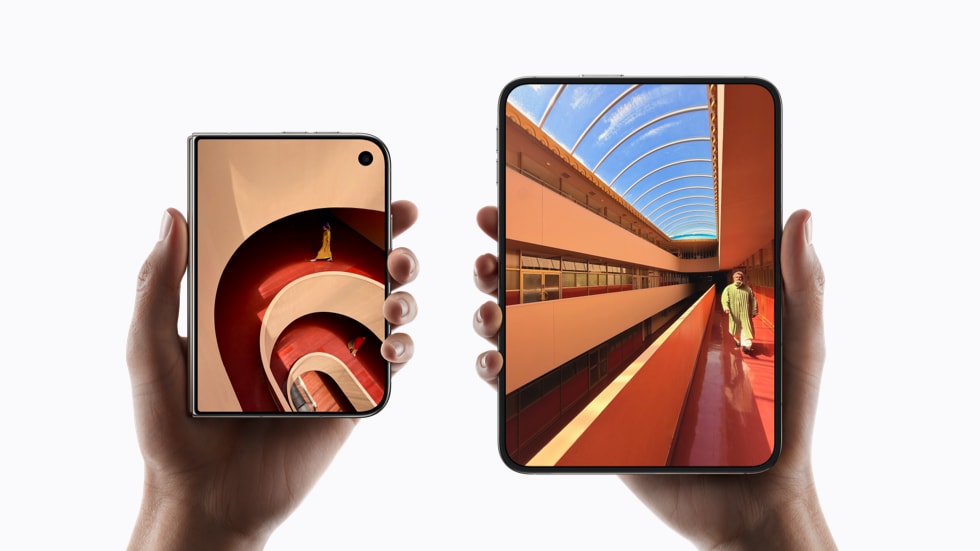
The outer display is a 5.4-inch panel, so this isn't a phone that folds down into something pocket-sized like a Flip. It's closer in spirit to Samsung's Fold line: a normal-ish phone on the outside, a small tablet on the inside.
Under the Hood: A20 Pro, 12GB RAM, and a Camera Built for Two Layouts
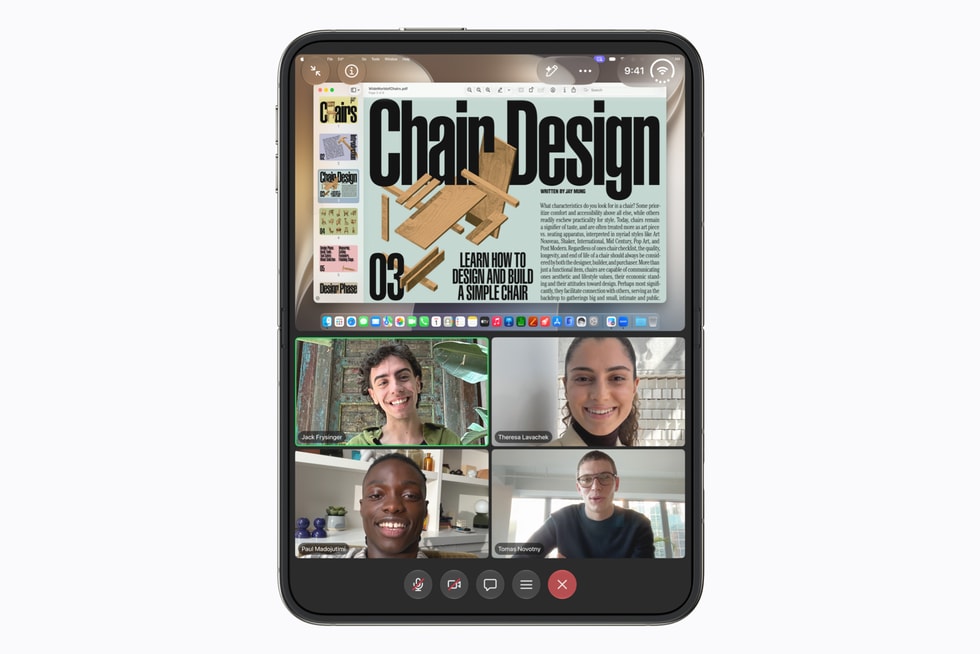
The Duo runs Apple's A20 Pro, built on TSMC's 2nm process (the same node most of this year's flagship silicon is chasing). It ships with 12GB of RAM, worth flagging because the Galaxy Z Fold 8, its most direct rival, ships with 16GB. On a phone built around running two apps side by side across that big inner display, RAM headroom isn't a vanity number on a spec sheet: it decides how many apps survive in the background without reloading. It's the one figure here I want stress-tested before pointing a power user toward this over the Fold 8.
The rear camera is a 48MP Dual Fusion system: a 48MP main (26mm, f/1.8) paired with a 48MP ultra-wide (13mm, f/2.2). More interesting is the front: Apple's first under-display FaceTime camera, tucked beneath the inner screen, plus a 12MP Center Stage camera on the outer display. The under-display camera is a first for any iPhone, and it's the kind of feature that only means something once you've video-called on a foldable. No notch or punch-hole breaks up the one screen you'd want to use for that.
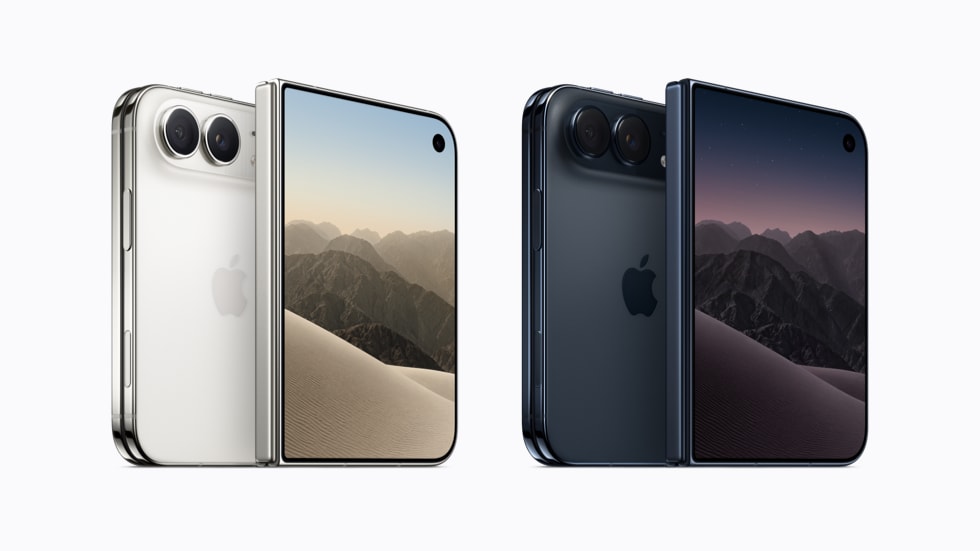
Battery is a 4,700mAh dual-cell setup, likely one battery per side of the hinge, and the phone ships on iOS 27. Build is Grade 5 titanium with a mirror-polished finish, Ceramic Shield 2 up front and Ceramic Shield on the back, rated IP68 (6 meters of water for 30 minutes). Unfolded, it's 5.2mm thick and 254 grams; folded, 11.3mm. Colors are Star White and Night Sky.
What Gives Me Pause
Two things nag at me. The RAM gap against the Fold 8 is the technical one: Apple has a real track record of making less RAM go further through tight software optimization, and iOS memory management is properly good, but "properly good" and "16GB" aren't the same claim. Only a real multitasking stress test will tell us which one actually wins.
The other is the price gap against everything else, including Apple's own lineup. At ₹2,99,900, the Duo isn't just expensive for a phone: it's expensive relative to what an 18 Pro Max gets you for meaningfully less. Apple is betting that enough people want the fold badly enough to pay a premium on top of an already-premium platform.
Who I Think This Is Actually For
Here's where I've landed, for whatever a pre-hands-on opinion is worth.
If your honest complaint about your current iPhone is a tired battery or a camera that's a step behind, skip this one — the 18 Pro Max fixes that for dramatically less money, and the Duo isn't built to win that argument.
But if your real complaint is that your phone feels too small for what you use it for, this might change your mind. You're the person pinching to zoom into a PDF every ten seconds, or opening WhatsApp on a laptop specifically because replying to long messages on a 6.1-inch screen is miserable. The 7.6-inch inner display solves a problem you've had for real, not one Apple invented to sell you an upgrade. That's a narrower crowd than "everyone due for a new iPhone," but it's not a small one, and I'd bet a fair number of them have been waiting for precisely this.
There's also the buyer who doesn't need any of that justification: someone who wants whatever Apple's best current phone is, full stop, for whom ₹3 lakh barely registers. That's a real customer too. I'd rather say so plainly than pretend price is nobody's concern here.
Who I wouldn't point toward this: anyone cross-shopping it against the Galaxy Z Fold 8 on a spreadsheet. The Fold 8 has 4GB more RAM for meaningfully less money, and until both phones go through the same multitasking test side by side, I'm not waving that gap away with "but it's Apple."
Bottom line: this doesn't read like a foldable for the masses, and I don't think Apple built it as one. It built its answer to "what would an iPhone look like with zero compromise on screen size," then priced it exactly like that sentence reads. Whether it's worth it comes down to one question only you can answer: is the small-screen problem yours, or would you be paying ₹3 lakh to invent one?
I'll have a full hands-on once retail units are out in India on October 23.
Are you even considering the iPhone Duo at this price, or is this one for a very specific kind of buyer? Tell me what you'd use that inner screen for. I'm curious how many people have a real use case versus just wanting the biggest, newest thing.


